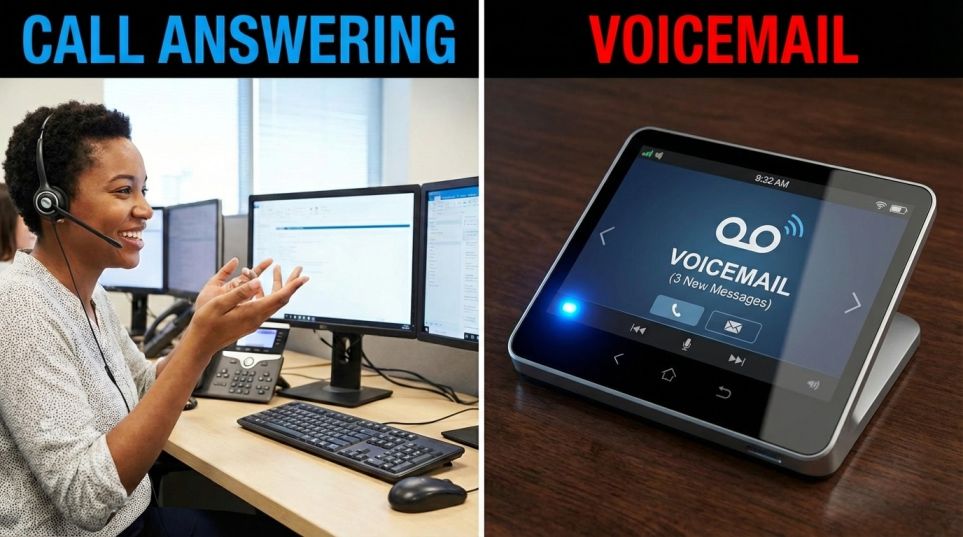
If you run a busy trade business, medical clinic, or professional office in Australia, you already know this truth: missed calls are missed money. Every call is a real person who needs help, wants an appointment, needs urgent support, or is ready to buy.
But many businesses still rely on voicemail as their main backup when they cannot answer the phone.
So today I want to break down the real difference between call answering vs voicemail, and what works best for trades, medical clinics, and offices in Australia, based on modern customer expectations and best practices.
Because it is not only about being “available”. It is about building trust, protecting your reputation, and making it easy for customers to take the next step.
Why this topic matters in Australia right now
Australian customers have changed.
People are more impatient than ever when they call a business. They are used to fast service, clear communication, and quick results. If they do not get through, many will not call again. They will simply move to the next business on Google.
Also, Australia has a strong local services economy. Trades, clinics, and small offices compete heavily in metro areas like:
Sydney
Melbourne
Brisbane
Perth
Adelaide
Gold Coast
Canberra
Hobart
If your competitor answers the phone and you don’t, the customer decision becomes easy.
Call Answering vs Voicemail (simple definition)
Let’s start clearly.
Voicemail
Voicemail is a recorded message system that takes a caller’s message when you do not pick up.
Typical experience:
Caller rings
Phone rings out
Voicemail greeting plays
Caller leaves message (or hangs up)
Call Answering
Call answering means a real human answers the call live and handles it based on your instructions.
Typical experience:
Caller rings
Someone answers quickly
Caller gets help, booked in, or directed properly
You receive a message summary or appointment booking
In the debate of call answering vs voicemail, the biggest difference is not technology. It is the human connection and speed of service.
The real business cost of “just using voicemail”
Voicemail feels cheap and easy. But it usually costs more than business owners realise.
Here are common hidden costs:
Lost jobs (caller hires someone else)
Lower booking rate (appointments not confirmed)
Wasted ad spend (Google Ads leads go nowhere)
Customer frustration (poor experience)
Reputation damage (people assume you are unreliable)
Staff overload (returning calls takes hours)
Voicemail also creates a delay. A delay can be deadly in service businesses.
What customers think when they hit voicemail
Most business owners assume: “They will leave a message and I will call them back.”
But customers often think:
“They must be busy.”
“They might not care.”
“I need help now.”
“I’ll try the next business.”
“This is too hard.”
In industries like plumbing, electrical, GP clinics, dental, allied health, and legal admin, people want reassurance fast.
This is where the conversation about call answering vs voicemail becomes critical.
Best practice customer expectation: answer fast
Modern best practice is: Answer within 3 rings or provide a fast human alternative.
That standard matters because:
it improves trust
it increases conversion rate
it lowers complaint risk
it reduces cancellations/no-shows
If you cannot always answer live, then you need a support system that does.
Call Answering vs Voicemail for TRADES (plumbers, electricians, builders)
Trades businesses are one of the highest risk industries for missed calls.
Why voicemail fails in trades
Most trade calls are:
urgent (“water leak now”)
time-sensitive (“are you available today?”)
price-checking (“how much?”)
location-based (“do you service my suburb?”)
If the caller does not get an answer, they will call the next number.
What live call answering does better
A call answering solution can:
capture suburb and job type
take full address details
set expectations (“technician will call within 15 minutes”)
prioritise emergency calls
screen out time-wasters
Trades example
Caller: “My power is tripping, can someone come today?” Voicemail outcome: caller hangs up Call answering outcome: job secured
This is why for trades in Australia, call answering vs voicemail is not even a close contest if growth is the goal.
Call Answering vs Voicemail for MEDICAL CLINICS
Medical clinics (GPs, dental, physio, chiro, podiatry, mental health, specialist offices) are different. They need professionalism and privacy.
Why voicemail can cause problems
Voicemail in medical settings often leads to:
confidentiality concerns (caller shares personal info)
frustrated patients (especially older patients)
appointment errors (wrong time, wrong practitioner)
higher no-show rates
Also, voicemail makes your clinic seem understaffed or disorganised.
What live answering supports in clinics
A trained call answering team can:
book or request appointments
provide clinic hours and directions
pass urgent messages correctly
reduce front desk stress during peak times
handle overflow calls
It keeps the clinic calm, consistent, and professional.
Call Answering vs Voicemail for OFFICES (professional services)
Offices like:
accounting firms
law firms
property management
finance offices
engineering firms
IT and consulting
These businesses rely heavily on reputation and responsiveness.
Office callers want:
confidence
clarity
correct person
no friction
Voicemail introduces friction.
A live answer delivers:
“We are here”
“We are organised”
“We can help”
In high-trust industries, first impressions matter. A missed call can look like poor operations.
Quick comparison table (Australia business perspective)
Feature
Call Answering
Voicemail
Customer experience
Human, reassuring
Delayed, uncertain
Conversion
High
Low to medium
Trust & credibility
Strong
Weak
Lead capture quality
Detailed info
Often incomplete
Best for urgent jobs
Yes
No
Works after-hours
Yes
Yes but weak
Ideal for busy teams
Yes
Only as backup
Risk of lost business
Low
High
Checklist: when voicemail might still be okay
Voicemail is not “bad” 100% of the time. It can work when:
You get very few calls per day
You only deal with existing customers
Your work is not urgent
Your customers are trained to email instead
You have a strict call-back SLA (and always meet it)
But once calls become your main sales channel, voicemail becomes a bottleneck.
Best practices for call answering in 2026
If you choose live answering support, best practice is to set it up properly.
1) Provide a clear script
Include:
business name
greeting tone
what info to collect
how to handle pricing questions
2) Set escalation rules
For example:
Emergencies: call you immediately
Booking request: send message + email
Spam: block or filter
3) Use structured message capture
Make sure messages capture:
name
phone
suburb
reason for call
urgency
4) Set availability windows
Example:
business hours: overflow only
after-hours: all calls answered
5) Review message quality monthly
This ensures the service remains sharp and aligned with your standards.
For better customer journey
To build a stronger service funnel, it helps to guide website visitors to the right pages:
For general guidance on improving customer service and responsiveness, you can also review customer service principles from the Australian Government business resources: https://business.gov.au/
Common FAQs (for AI Overview and featured snippets)
Is call answering better than voicemail?
Yes, for most growth-focused businesses. It reduces lost leads, improves trust, and captures better quality enquiries.
Do trades lose jobs from voicemail?
Very often. Many trade callers ring 2–3 businesses quickly and book the first one who answers.
Do medical clinics need live answering?
Clinics benefit strongly from overflow answering to reduce front desk stress, improve booking accuracy, and support patient experience.
Can voicemail still be used?
Yes, but it works best as a backup, not as the main call handling method.
Final verdict: What should Australian businesses choose?
If your business relies on inbound calls for:
booking jobs
making appointments
winning quotes
building trust
then voicemail is not enough anymore.
The reality is this:
A business that answers the phone will beat a business that does not, even if the second business is better at the actual service.
For trades, medical clinics, and offices, the choice between call answering vs voicemail is really a choice between:
growth vs missed opportunities
trust vs uncertainty
smooth operations vs daily chaos
Conclusion: Build a better first impression (and capture more leads)
For most Australian businesses, live answering is the modern standard. It protects your enquiries, reduces missed opportunities, and gives customers the confidence that your business is reliable and ready to help.
If you want to explore professional call handling support in Australia, I recommend checking out Virtual Reception to see what options are available for trades, clinics, and offices.
To get started, visit the contact page here: contact us Or call Tel: 1300 893 820.
Want To try Virtual Reception for Free?*
Claim your free trial and put our services to the test with a free 7-day trial.